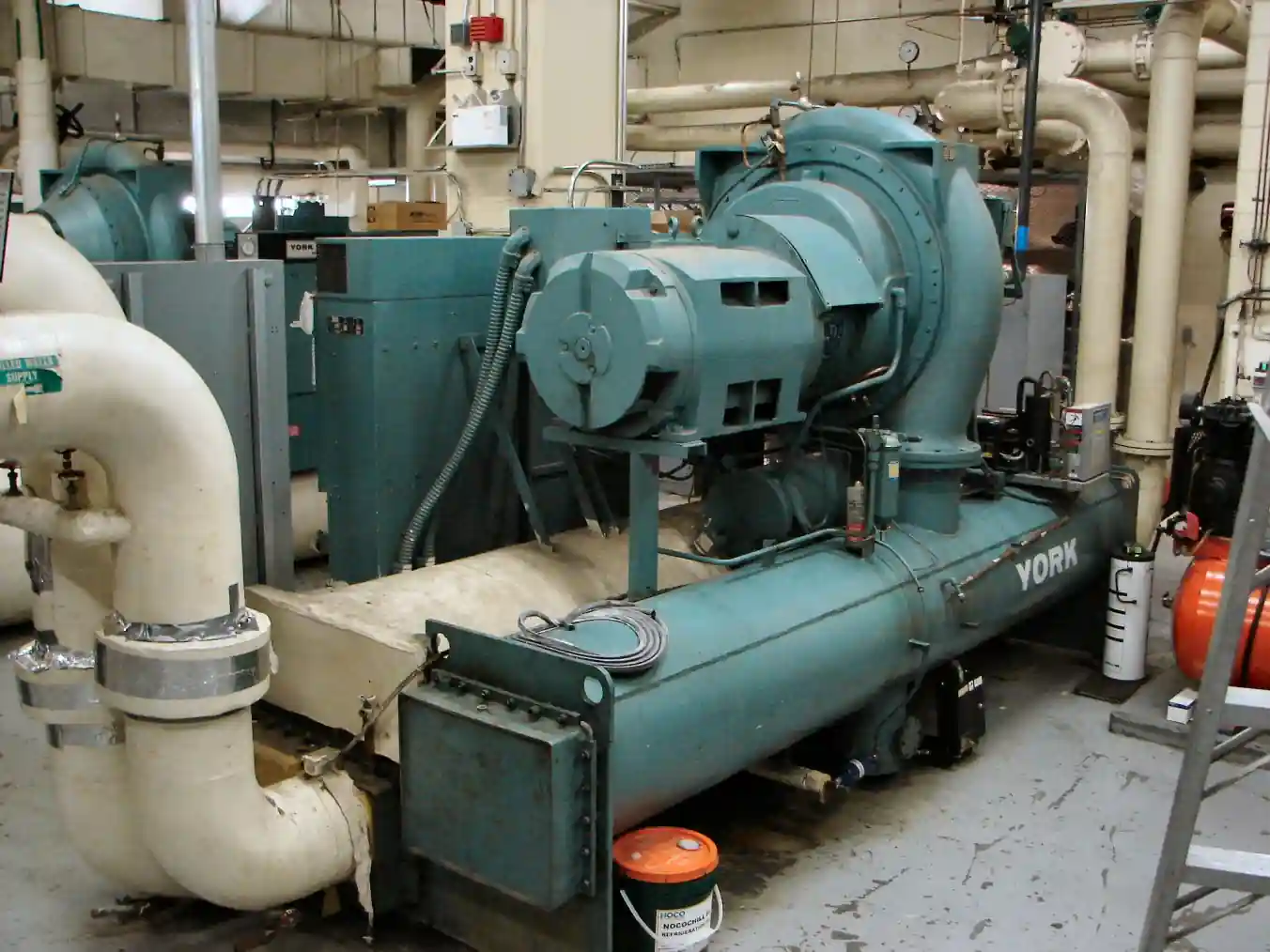
An absorption chiller is a refrigeration machine that produces chilled water using heat as its driving energy and a liquid working pair instead of a mechanically driven compressor. In the dominant water and lithium bromide machines, water is the refrigerant evaporating in a vacuum vessel to chill the water circuit, lithium bromide solution is the absorbent capturing that vapor, and a generator section driven by steam, hot water, direct gas firing, or engine and turbine exhaust boils the refrigerant back out of solution to close the cycle. Ammonia-water machines serve industrial and low temperature duties on the same absorption principle. The US Department of Energy's CHP absorption chiller guidance is a representative reference, and this page treats the complete machine, vessels, heat exchangers, purge, and controls, as the purchasing object.
This page is written for the engineer specifying an absorption chiller for a combined heat and power plant, a waste heat recovery project, a district cooling scheme, or an industrial process cooling load. It works through what the machine does and what is being bought, how the absorption cycle turns low grade heat into cold, which machine classes fit which heat sources, the parameters that appear on vendor data sheets, and the selection factors and RFQ language that decide whether the chiller delivers its tonnage from the available heat for a vacuum integrity and service budget that stays predictable.
The decision concentrates in five places: the driving heat source and its temperature, steam, hot water, exhaust, or direct firing, the temperature the chilled water must reach and the load it must carry, the cycle class, single-effect or double-effect, that the heat grade supports, the working pair, lithium bromide for comfort and process water, ammonia-water for low temperature, and the condenser heat rejection, usually a cooling tower, that the site can supply. Get those right and the COP, the vessel sizes, and the purge system follow with little freedom.
Chapter 1 / 06
What an Absorption Chiller Is and What Is Being Decided
The machine this page describes is a factory package of four main vessels and their internal heat exchangers: an evaporator where refrigerant water sprays over chilled water tubes in a deep vacuum and chills the circuit by evaporation, an absorber where concentrated lithium bromide solution absorbs that vapor and rejects absorption heat to condenser water, a generator where driving heat boils refrigerant out of the dilute solution, and a condenser where the boiled refrigerant condenses before returning to the evaporator through an orifice or float. A solution pump moves the solution loop, a shell-and-tube heat exchanger recovers heat between the strong and weak solution legs, and a purge unit holds the vacuum by removing noncondensables. In direct-fired machines a burner replaces the steam generator coil; in exhaust-fired machines the engine or turbine exhaust flows through generator tubes.
What is being decided when an absorption chiller is purchased is a chilled water duty delivered from a specified heat source with a guaranteed coefficient of performance and vacuum integrity. The buyer is purchasing a stated cooling capacity in kilowatts or refrigeration tons from a stated driving heat at a stated temperature and flow, producing chilled water at a stated supply temperature, rejecting condenser heat at a stated entering water temperature, with a COP, cooling out divided by heat in, the vendor will guarantee at those conditions. Everything on the vendor data sheet, vessel arrangement, solution heat exchanger effectiveness, purge capacity, exists to support those guarantees, and the honest vendor quotes performance at the site's real condenser water temperature, not at a flattering laboratory rating point.
The absorption chiller sits in the cooling plant family with defined neighbors. It is not the vapor compression chiller, the electric machine whose centrifugal compressor or screw compressor pumps refrigerant vapor mechanically, the family's workhorse that this encyclopedia's chiller family page covers, and the two machines often share a plant, electric machines for the base, absorption for the heat-backed share. It is not the industrial heat pump, which raises heat to a higher temperature for use rather than producing cold from heat. It rejects heat through a cooling tower or a dry system exactly as any chiller does, and in steam plants it sits beside the deaerator, the economizer, the superheater, and the steam drum of the boiler cycle that feeds it, drawing extraction or exhaust steam and returning condensate through a condensate return pump to the boiler feed pump suction.
Different buyers buy the same machine for different heats. A combined heat and power plant buys steam or exhaust-fired machines to convert summer surplus heat into cooling, selling or using trigeneration, and the same plant may run feedwater heaters on its steam turbine cycle in winter. A data center or factory buys hot water machines off engine jacket and aftercooler heat, gas turbine inlet air chilling being the classic application that turns exhaust heat into more turbine output on hot days. A district cooling scheme buys large steam or direct-fired double-effect machines at a central plant. A chemical or pharmaceutical site buys ammonia-water machines for low temperature brine where lithium bromide cannot reach. A hydrogen plant built around a steam methane reformer, or a fired heater stack with recoverable heat, exports low pressure steam that absorption machines convert to process cooling. The specification language differs, but the solution thermodynamics is shared.
The economics deserve their own paragraph because the absorption machine is bought to burn what would otherwise be wasted. Its electric consumption is a small fraction of a compression machine's, a solution pump and controls rather than a compressor, so where heat is free or nearly so, CHP exhaust, jacket water, waste steam vented through a dump condenser, the absorption tonnage is paid for by avoided electricity and demand charges; where heat must be burned as fuel for this purpose alone, the arithmetic usually favors the electric machine. The comparison the buyer actually makes is the total cost per ton hour at the site's blended electricity and fuel prices, and an RFQ that does not carry those prices cannot be optimized by anyone.
A short tour of named installations makes the machine concrete. At a campus CHP plant, a gas turbine's exhaust raises steam in a heat recovery steam generator, steam drives the turbine or serves campus heat, and summer steam feeds double-effect absorption machines that carry the cooling load while a standby electric chiller covers peaks. At a remote factory, gas engine jacket water at ninety degrees feeds single-effect machines for process cooling with no grid connection for compression. At an industrial gas site, low temperature ammonia-water machines serve condensation duty that a lithium bromide machine cannot reach. Each installation names the same knobs, heat grade, cycle class, COP, and condenser water, with sizes that scale while the absorption physics barely changes.
Chapter 2 / 06
How the Absorption Cycle Does the Work
The evaporator is where the product is made. Chilled water tubes pass through a vessel held at the deep vacuum corresponding to refrigerant water's saturation at the chilled water supply temperature, a few millimeters of mercury absolute; water sprayed over the tubes flashes and evaporates at that low pressure, taking its latent heat from the chilled water circuit and chilling it by the few degrees the system is designed around. The vacuum is not an accessory, it is the operating condition: the machine works because water boils near four degrees Celsius when the pressure is low enough, and every leak that raises pressure costs capacity directly.
The absorber is the compressor's analog and the cycle's signature. Refrigerant vapor from the evaporator flows to the absorber, where concentrated lithium bromide solution sprayed over condenser water tubes captures the vapor into solution, an exothermic process whose heat the condenser water carries away; the dilute solution collects at the bottom, and its level is the working inventory of the cycle. Absorption replaces the suction stroke of a compressor, a pump then moves the dilute solution to the generator through the solution heat exchanger, and the pressure difference between the low side and the high side, a few kilopascals against several, is held by nothing more than columns and orifices, which is why the machine has no compressor to buy power for.
The generator and condenser close the loop at the high side. Driving heat, steam condensing in tubes, hot water, exhaust gas, or a burner, boils refrigerant water out of the dilute solution in the generator; the concentrated solution returns through the solution heat exchanger, giving up heat to the outgoing dilute stream, to the absorber to absorb again. The boiled-off refrigerant vapor condenses in the condenser, rejecting heat to the same condenser water circuit as the absorber, and the liquid refrigerant returns to the evaporator through a restriction. In double-effect machines the first stage generator's vapor becomes the heat source of a second generator stage, using the same driving heat twice and lifting the COP accordingly.
The COP bands follow from that staging. Single-effect lithium bromide machines, driven by low pressure steam or hot water in the eighty-five to one hundred degree class, deliver a COP near 0.7, seven units of cold per ten units of heat. Double-effect machines, driven by medium pressure steam or direct firing at roughly twice the temperature, deliver COPs near 1.1 to 1.4 by cascading the generator stages. Ammonia-water machines span a wider field by configuration, with industrial units from below 0.5 for deep low temperature service to above 1.0 in staged designs. These are steady-state figures at rated condenser water temperature; every degree hotter the cooling tower delivers costs capacity and COP, and the site's worst design day, not the annual average, sizes the machine.
Crystallization and air are the cycle's two honest enemies. Lithium bromide solubility falls with temperature, so a combination of high condenser water temperature and high generator concentration can drive the solution to salt out, crystallizing in lines and passages and stopping the machine, and designs fight it with concentration limits, dilution cycles at shutdown, and controls that sense the approach to the crystallization margin. Air in-leakage raises the evaporator pressure, throttles absorption, and corrodes the steel, so the purge unit, mechanical or solution-level, runs continuously to remove noncondensables, and vacuum integrity testing is a commissioning and periodic maintenance ritual the owner cannot skip. An absorption machine that holds its vacuum and avoids crystallization is nearly indestructible; one that does neither fails its guarantees within a season.
Capacity control trims the cycle to the load. The standard handle is the driving heat input, burner firing, steam valve, or hot water flow, with the solution pump and refrigerant routing following in more advanced machines, and modern controllers modulate down to a fraction of rated capacity while monitoring approach to crystallization margins and purge duty. Response is slower than a compression machine's, thermal masses rather than a compressor speed set the pace, and plants that must swing fast often hybridize, absorption carrying the steady base with an electric machine trimming. The control scope in the RFQ, chilled water reset, condenser water relief, dilution at shutdown, remote monitoring of vacuum, decides whether the machine runs its guarantees year after year.
Chapter 3 / 06
Chiller Types, Heat Sources, and Machine Boundaries
Steam-driven single-effect machines are the entry class for sites with low pressure steam: generator coils condense steam at a few bar or less, COP near 0.7, capacities from tens to thousands of kilowatts, and the condensate returns to the steam cycle. Hot-water machines take jacket water, solar heat, or process hot water at eighty-five degrees and up, the same cycle in a coil arrangement sized for liquid heating, and they are the standard choice for engine CHP where the heat is already liquid-borne. Both classes tolerate heat grade swings better than the double-effect machine and forgive the modest control infrastructure of small sites.
Double-effect machines are the efficiency class. Medium pressure steam or direct gas firing drives a first-stage generator whose refrigerant vapor heats a second generator, COP near 1.1 to 1.4, and the same capacity is delivered from less heat or more capacity from the same heat. Direct-fired double-effect machines carry their own burner and are the backbone of district cooling and gas-fired trigeneration plants; exhaust-fired versions route engine or turbine exhaust through the generator, combining with jacket water circuits in hybrid CHP packages. The price of the second effect is heat grade sensitivity and a tighter control envelope, and the class repays it wherever fuel or exhaust heat is abundant.
Ammonia-water machines serve where the product is colder than water can chill. The working pair inverts, ammonia is the refrigerant and water the absorbent, the cycle runs at positive pressures rather than vacuum, and machines reach brine temperatures well below zero for food, chemical, and gas processing duty. They are bought as industrial refrigeration, packaged or field-erected, with COPs that depend on configuration, and their boundary with the lithium bromide classes is the chilled medium temperature the process needs: above roughly four degrees the lithium bromide machine owns the field, below it ammonia-water or a compression alternative does the work.
Solar and waste-heat subclasses are applications of the same machines rather than different hardware. Solar-assisted machines take hot water from collectors, single-effect because collector temperature is modest; waste-heat machines take streams from engines, kilns, fuel cells, and process condensers, with the generator coil matched to the stream's temperature and cleanliness. Absorption heat pumps, the machine run backward for heating duty, neighbor this page's cooling machine and the industrial heat pump page covers that direction of use. The boundaries worth stating clearly: this is not a desiccant or adsorption dryer for compressed air, and it is not a vapor compression machine, so instrument air duties belong to an air dryer and electric tonnage to the chiller family page.
Adjacent machines complete the plant picture. Heat rejection is the big one: nearly every lithium bromide machine rejects absorber and condenser heat to a cooling tower water circuit, and where water is scarce a dry system or an air cooled heat exchanger variant of the plant serves, at a capacity and COP penalty the RFQ must price. The vacuum duty may be held by a steam ejector or a mechanical vacuum pump at startup or continuously. The heat source side carries its own neighbors, the heat recovery steam generator and gas turbine of a CHP block, the engine's jacket and aftercooler circuits, the hydrogen electrolyzer plant needing steady process cooling, and the steam cycle hardware already named. Within the absorption family itself, the classes differ by stages and working pair, not species, and the RFQ should state heat source, grade, and chilled water temperature rather than asking for an absorption chiller and hoping.
Chapter 4 / 06
Key Specification Parameters
The vendor data sheet for an absorption chiller centers on capacity, COP, and the water temperatures on both sides, and each number carries a purchasing consequence. The table below lists the parameters that recur across manufacturers' catalogs, with typical ranges for lithium bromide service; values for a specific project come from the heat source and load profile, and the ranges here are orientation, not a substitute for a site-specific selection.
Parameter
Typical catalog range
What it decides
Cooling capacity
35 kW to 6 MW per machine
Machine count; heat source sizing
Chilled water supply
5 to 12 C water/LiBr; -30 to 0 C ammonia brine
Working pair and cycle class
Driving heat input
hot water 85-150 C; steam 0.1-1 MPa; exhaust 250-500 C
Single vs double effect; source match
COP, thermal
0.6-0.8 single effect; 1.1-1.4 double effect
Heat consumption per unit of cooling
Condenser water entering
24 to 34 C design basis
Capacity and crystallization margin
Electric consumption
1 to 3 percent of driven equivalent
Parasitic load; solution pump power
Part load range
20 to 100 percent modulating
Seasonal matching; hybrid need
Solution charge and purge
machine specific; continuous purge unit
Vacuum integrity; service regime
Three of these numbers deserve the buyer's suspicion when they arrive without a basis. Capacity quoted at a condenser water temperature cooler than the site's cooling tower will deliver on a design day is the classic flattery. COP quoted at full load hides the part-load curve where the machine actually lives. Driving heat quoted as a range without stating the capacity delivered at each end leaves the buyer to discover that the low grade end of the range is a derated machine. An RFQ that fixes the rating point, design condenser water, supply and return chilled water, and heat source at rated, separates engineered offers from assembled ones.
Materials and construction follow the working pair and the heat source. Lithium bromide machines are carbon steel vessels with copper or copper-nickel tubes, inhibitors and film-forming chemistry protecting steel against the aggressive brine, and stainless internals where corrosion history argues; direct-fired generators add combustion-side hardware and burner management. Ammonia machines carry pressurized steel vessels and ammonia-rated components throughout. Purge units, vacuum-rated instrumentation, and solution sampling arrangements are standard scope and their absence from a quote is a warning. Fouling factors on chilled and condenser waters should be stated to the site's actual water treatment practice, because a fouled absorber loses capacity exactly as a fouled condenser does.
Chapter 5 / 06
Selection Decision Factors and RFQ Language
Selection starts with the heat, not the catalog. The available heat source, its grade, its schedule, and its alternative use set the machine class: low grade liquid heat says single-effect hot water, medium pressure steam or clean exhaust says double-effect, fuel burned specifically for cooling says direct-fired and must win the electric comparison first. The load profile sets the size and the hybrid question, steady district and process loads suit absorption alone, swinging loads suit absorption base with electric trim. The condenser water regime sets the real capacity and the crystallization margin, and the site's worst wet bulb day belongs in the RFQ as the design point.
The working pair choice follows the chilled medium. Comfort and ordinary process cooling above four degrees is lithium bromide territory; low temperature brine and industrial refrigeration is ammonia-water or compression territory, and the boundary case, a plant needing both temperatures, is often best served by two machines rather than one compromise. Water scarcity pushes toward dry heat rejection with its capacity penalty, or toward hybrid plants that reject less heat overall. Steam host constraints matter too: an absorption machine on a CHP steam header competes with winter heat and feedwater heating for the same steam, and the annual energy model, not the summer rating point, decides the purchase.
The table below organizes the decision into the factors that recur across projects, with the questions the buyer should be able to answer before the RFQ goes out. Each row is a place where an incomplete answer turns into an underspecified machine and a capacity argument later.
Decision factor
What the buyer must state
Consequence if left open
Heat source
Type, grade, flow, schedule, and competing uses
Wrong cycle class; heat and machine mismatched
Cooling load
Capacity, chilled water temperatures, load profile by season
Sizing error; hybrid need unrecognized
Rating point
Design condenser water temperature and fouling factors
Guarantee at a point the site never sees
Working pair
Chilled medium and its temperature
LiBr/ammonia boundary mishandled
Heat rejection
Cooling tower water regime or dry alternative
Capacity and crystallization margin wrong
Utility prices
Blended electricity and fuel prices for the comparison
Buyer cannot verify the economics
Service infrastructure
Vacuum service capability, spare parts, monitoring
First vacuum loss ends the guarantees
RFQ language for an absorption chiller should name the heat and the rating point. A workable specification states: cooling capacity at chilled water supply and return temperatures; driving heat source, grade, and flow available at rated capacity; required COP and the rating conditions it applies to; design condenser water temperature from the site's cooling tower or dry system with fouling factors; machine class intent, single or double effect, steam, hot water, exhaust, or direct fired; working pair by chilled medium; purge and vacuum integrity scope with monitoring outputs; electrical scope, solution pump power, controls, and interfaces; and the acceptance basis, witnessed capacity test at the stated rating point with vacuum decay criteria. Naming the plant neighbors helps the vendor, the heat recovery steam generator or engine exhaust source, the cooling tower, any feedwater heater competing for the same steam, so the connections and the heat balance land in the right bids.
Chapter 6 / 06
Installation, Standards, Failure Modes, and Maintenance
Installation is a rigging and piping job with a vacuum ritual at the end. The machine arrives charged or charged on site, is set on its pads with the chilled, condenser, and heat source piping hung to allow thermal growth, and the purge and controls are wired. Commissioning proves the vacuum first, a standing vacuum decay test before water ever circulates, then the water balances, then the heat source introduced in the order the vendor's procedure states, and capacity is verified against the rating point at stable conditions. Direct-fired machines add combustion and burner management commissioning to the list, and exhaust-fired machines add the engine or turbine interface with its backpressure limits checked on the source machine.
Standards for these machines follow the pressure and combustion regimes they live in. Lithium bromide vessels run vacuum to modest pressure and are built to the jurisdiction's pressure equipment framework with the code stamping that implies; direct-fired machines add burner safety standards and gas codes; ammonia machines carry ammonia refrigeration safety practice and their own inspection regimes; and electrical, controls, and lifting hardware follow the plant's ordinary standards. Performance rating conventions for chillers are standardized in the industry's test and rating documents, and an RFQ should name the rating basis rather than assume the vendor's. Any edition reference in project documents should be checked against the current issue at purchase rather than copied from an old specification.
The recurring failure modes are vacuum and solution chemistry, and they announce themselves slowly. Air in-leakage, through flanges, valves, or cracked tubes, raises evaporator pressure, cuts capacity, and accelerates corrosion inside the machine, and the purge system's duty cycle is the early warning; a purge that runs constantly is a leak campaign waiting. Crystallization, already described, stops the machine when condenser water runs hot against concentration limits, and controls that dilute at shutdown and sense the margin are the difference between an alarm and an outage. Tube fouling on condenser and chilled circuits erodes capacity season by season. Tube corrosion, copper in aggressive water, steel under air, eventually forces retubing, and solution analysis, inhibitor and contaminant tracking, is the owner's early instrument.
Maintenance planning is a calendar and a chemistry log. The table below lists the actions with the typical cadence a plant will schedule, assembled from common vendor practice; actual intervals follow the site's water treatment, heat source cleanliness, and load utilization and should be set from the first year's operating data.
Inspect and clean chilled and condenser water sides
Annual, water quality dependent
Burner and combustion, direct fired
Tune, flue gas analysis, safety shutoff test
Annual
Controls and dilution logic
Verify dilution cycle, alarms, margin settings
Annual pre-season
Pumps and purge unit
Service solution pump, purge per vendor
Per operating hours
Absorbent and refrigerant charge
Rebalance or replace per analysis
As analysis directs
Long term care keeps the machine's two currencies, vacuum and chemistry, honest for decades. Absorption machines routinely outlive their compression neighbors because their only rotating part is a small pump, but only in plants that log purge duty, sample the solution, and clean tubes on schedule; the machine that lacks that discipline loses its capacity a little every year until someone measures it against the guarantee and finds it gone. Retrofit options, advanced purge, digital vacuum monitoring, and tube coatings, extend legacy machines, and the plant that treats the absorption chiller as a chemistry-bearing asset, rather than a box of cold, is the plant whose CHP economics still work in year twenty.
FAQ
What is the difference between an absorption chiller and an electric chiller?
An absorption chiller drives its refrigeration cycle with heat, steam, hot water, exhaust, or direct firing, and a liquid working pair, usually water absorbed by lithium bromide solution, replaces the compressor. An electric chiller drives its cycle with a motor on a centrifugal or screw compressor. Absorption machines consume a few percent of the electricity of an equivalent compression machine, run quietly with few moving parts, and make sense where heat is cheap or waste; compression machines make sense where electricity is the only energy and full load efficiency governs.
What do single-effect and double-effect mean?
They count how many times the driving heat is used to boil refrigerant out of solution. A single-effect machine boils it once, accepts low grade heat such as 90 C hot water or low pressure steam, and delivers a COP near 0.7. A double-effect machine uses the vapor from a first, hotter generator stage to drive a second generator, needs medium pressure steam, direct firing, or hot exhaust, and delivers a COP near 1.1 to 1.4. The heat grade available at the site, not preference, chooses the class.
What COP should an absorption chiller deliver?
Lithium bromide machines deliver roughly 0.7 thermal COP in single-effect and 1.1 to 1.4 in double-effect service at rated conditions, meaning 0.7 to 1.4 units of cooling per unit of driving heat. Ammonia-water machines range from below 0.5 for deep low temperature service to above 1.0 in staged configurations. The guaranteed COP applies at a stated condenser water temperature and load; hotter cooling tower water or heavy fouling reduces both COP and capacity, so the RFQ should fix the rating point.
What heat sources can drive an absorption chiller?
Low pressure steam from a CHP plant or process header, hot water from engine jacket and aftercooler circuits, solar collectors, clean engine or gas turbine exhaust, direct gas firing in double-effect machines, and low grade waste streams from kilns, fuel cells, and process condensers. The grade matters: 85 C hot water barely supports single effect, medium pressure steam and 250 C-plus exhaust support double effect, and any candidate stream must be matched to the generator coil design for temperature and cleanliness.
Why do lithium bromide chillers crystallize and how is it prevented?
Lithium bromide solubility falls as solution temperature falls, so a machine running high generator concentration against unusually hot condenser water can salt out, plugging solution passages and stopping the cycle. Prevention is a design and control discipline: concentration limits with margin to the crystallization line, condenser water temperature limits, automatic dilution cycles at shutdown, and controls that sense the approach to the margin. When it happens despite this, controlled dilution and heat clears it without hardware damage.
Is an absorption chiller suitable for low temperature refrigeration?
Not in the common lithium bromide form, because water is the refrigerant and the machine chills water no colder than a few degrees above freezing. Low temperature brine and industrial refrigeration duties use ammonia-water absorption machines, which reach tens of degrees below zero, or vapor compression refrigeration. The chilled medium temperature at the site decides the working pair before any vendor conversation begins.
What should an absorption chiller RFQ include?
State the cooling capacity at chilled water supply and return temperatures, the driving heat source with its grade, flow, and schedule, the required COP and its rating conditions including design condenser water temperature and fouling factors, the intended class and firing arrangement, the working pair by chilled medium, purge and vacuum monitoring scope, electrical and control interfaces, and the acceptance basis with a witnessed capacity test and vacuum decay criteria. Naming the heat source plant, the heat recovery steam generator, engine, or cooling tower, lets vendors bid the interfaces correctly.