A Merox unit is a refinery or gas-plant treating package for mercaptans. Extractive systems remove suitable mercaptans from light hydrocarbon into caustic and oxidize them in a separate regeneration circuit. Fixed-bed sweetening can oxidize mercaptans to disulfides that remain in the fuel. Choosing a process therefore begins with the feed analysis and the difference between an outlet mercaptan limit and a total sulfur limit.
The installed package needs compatible pretreatment, oxidation and phase handling, testable stream guarantees and approved destinations for its by-products. A tender can then compare the equipment, utilities, chemical consumption and disposal burden over the same feed envelope.
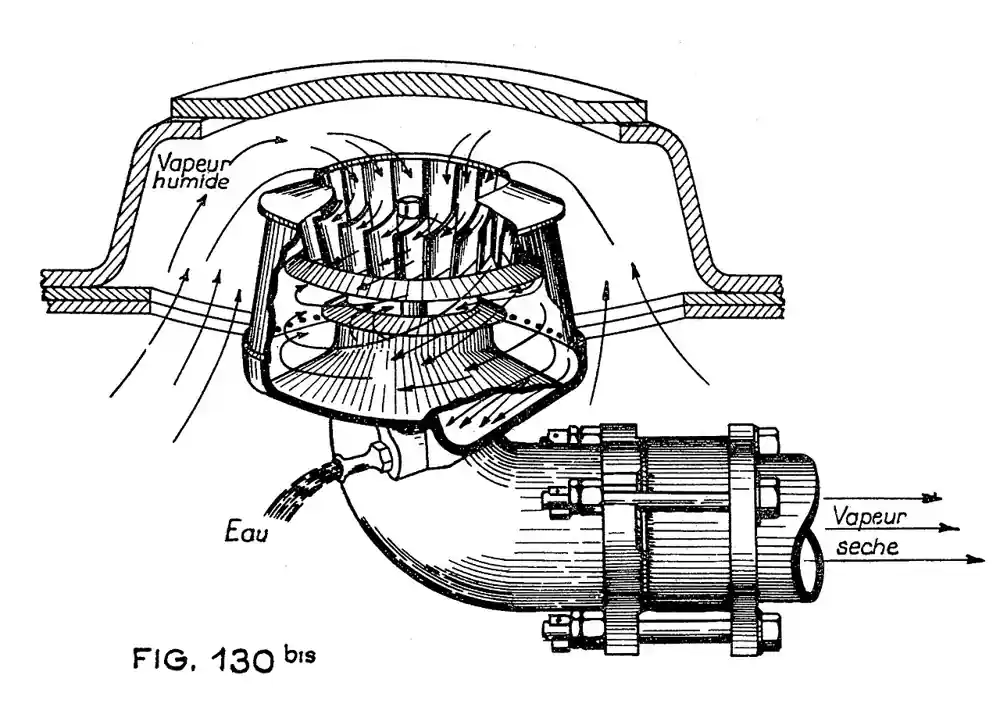
Historic Elesco water separator. Context photo: Scanned by Didier Duforest, CC0 via Wikimedia Commons.
Define whether the sulfur has to leave the product, what analytical method decides acceptance, and where the caustic, disulfide oil, vent gas and water go. Those decisions set the architecture and purchase scope.
Chapter 1 / 06
What a Merox Unit Is Bought to Do
Merox is Honeywell UOP's name for a family of processes that treat mercaptans in petroleum products [1]. Mercaptans, also called thiols, contain sulfur and have a characteristic odor. Treating changes what those compounds are or where they leave the process. The essential refinery decision is whether the finished hydrocarbon must contain less mercaptan sulfur, less total sulfur, or both. The two measurements are not interchangeable. In sweetening, mercaptans become disulfides and can remain dissolved in the product. Where a process extracts mercaptans into a separate alkaline phase before oxidation, some sulfur can leave the hydrocarbon as a separately managed disulfide stream.
A Merox unit is a treating package built around the selected process configuration. Its supply may include feed pretreatment, a hydrocarbon contactor or reactor, caustic circulation hardware, separation and washing, utilities and waste interfaces. The layout can differ substantially for LPG and kerosene service. Ask a licensor for a drawing with the location and phase of every feed, chemical and final stream. A bid entitled Merox unit is meaningful only after the owner defines which operations and guarantees are inside the package. For example, feed pretreatment may belong to a separate package with a concentration limit guaranteed at the Merox inlet.
Feed labels are a screening aid, not a substitute for analysis. LPG, light naphtha, other gasoline-range feeds and kerosene span different operating conditions and families of mercaptan compounds. Two samples with the same reported mercaptan sulfur can contain species with different physical and chemical properties. Some may be readily extracted by caustic, while less extractable species drive a sweetening or other treating choice. A representative feed characterization should distinguish mercaptan sulfur, hydrogen sulfide, and total sulfur, and include information relevant to phase handling and any known contaminants from upstream processing. State the methods and units with each result so that comparisons remain meaningful.
Select the receiving specification before choosing a flowsheet. One receiving stream may have a numerical mercaptan-sulfur limit, another a qualitative test requirement, and another a maximum total sulfur claim. Long before bids are priced, determine which test and stream point define acceptance. If delivery involves blending, decide whether the limit is applied before or after it and what material will be available for sampling. A successful treating run on a benign feed cannot establish the same result when a difficult feed arrives. Contractual guarantees should identify the credible feed compositions under which they apply.
The process boundary differs from those of an amine unit and a hydrotreater. Amine treating commonly removes acid gases such as hydrogen sulfide from appropriate streams. Hydrotreating uses hydrogen and a catalyst for a different treating duty and may be required where a fuel needs total sulfur reduction beyond what a particular Merox duty can achieve. An amine system can be upstream of a Merox feed; a hydrotreating route may be an alternative or an additional treatment in a more complex refinery. Comparison belongs at the chosen refinery stream and specification rather than under an umbrella label such as sulfur removal.
Buyer question
Input to establish
Contract implication
What is the feed?
Named stream, liquid or pressurized liquid basis, rate, temperature and analysis
Controls contactor design, sampling and materials
What constitutes sweet product?
Mercaptan-sulfur limit and specified analytical or qualitative test
Prevents confusing a mercaptan endpoint with total sulfur
Does sulfur have to leave the product?
Inlet and maximum outlet total sulfur plus sulfur species
Determines whether conversion in the product can meet the duty
How will sourness be handled upstream?
Hydrogen sulfide, possible excursions and the pretreatment boundary
Separates responsibilities and tests the feed limit
Where do by-products go?
Disulfide oil, spent caustic, vent and wash water destinations
Defines offsite cost and release constraints
A request for a complete unit should also describe how off-spec product is managed during feed variability or transition. A temporary recycle, storage allocation, or reduction in feed may be available at one refinery and impossible at another. Those plant constraints shape the size of auxiliary vessels, routing connections, and acceptance rules. Ask which off-spec scenarios belong in the equipment design and which are excluded by the operating envelope. The aim is to buy a package a receiving plant can use, with a clear written interface when an assumed upstream or downstream service is unavailable.
Chapter 2 / 06
Extractive Merox and Caustic Regeneration
In extraction, hydrocarbon contacts an alkaline liquid and the soluble mercaptan fraction transfers into the caustic as mercaptide. The phases then separate. A caustic stream carrying mercaptides goes to a separate oxidation and regeneration service, where the extracted sulfur species are converted to disulfides. A separator removes disulfide oil from alkaline liquid that can be circulated again. Barben's application note illustrates a light-feed extraction arrangement using pretreatment, extraction, regeneration, separation and product cleanup [2]. Individual licensed designs can vary. The bid should identify which blocks apply to the actual feed and locate their interfaces on the process flow diagram.
Extraction capacity is influenced by feed composition, especially which mercaptan species are present. It is also shaped by the equilibrium between the hydrocarbon and caustic phases and by how the contactor brings those phases together. A mass transfer device is sized differently from a storage vessel even if the drawings have similar silhouettes. Providing only a hydrocarbon flow rate invites the bidder to assume favorable solubility, capacity, and phase disengagement. Ask for the design basis for liquid traffic and carryover at both ends of the operating range. A supplier can state limits and predictions without disclosing its licensed proprietary sizing methods.
The caustic line from the extractor to the oxidation section and the return line are different duties. Each can have different composition, corrosivity and contaminants even though both circulate an alkaline aqueous liquid. The licensor should identify what its caustic strength specification means at each location and how strength is measured. A pH reading is useful in suitable services, but it should not be assumed to represent active caustic concentration or oxidation completion by itself. The purchase should include makeup and bleed expectations, the composition limits used when forecasting performance, and the analysis needed to reconcile actual consumption.
Air supplies oxygen to the regeneration service of a design that uses air oxidation. The package controls and safety basis have to account for the presence of hydrocarbon, caustic and oxygen-containing gas in connected equipment. Ask the licensor to define acceptable air quality, utility availability, gas routing, analyzer responsibilities and permissive logic within its design scope. Treat a specified air connection as a process interface with a documented range and hazards review, rather than as a generic plant air fitting. Vendor documents should establish the services that must stay segregated and the approved dispositions of gas over the allowed modes.
The disulfide separator is a key outlet for extracted sulfur. Successful oxidation alone cannot ensure low sulfur carryback if disulfide-rich liquid is poorly separated from the returned caustic. A three-phase separator can house distinct gas and two liquid exits where the design calls for that arrangement. The bid should show interface detection, routing and disposal specifications for each phase. Specify a credible range in entrained liquid, expected disulfide-oil quantity and disposal classification. Make the ownership of industrial sampling clear. A product sulfur result should be traceable to the recycle condition and disulfide separation without guessing how the phases were inventoried.
Product cleanup can include additional separation, washing or drying to remove material that accompanied the treated hydrocarbon. Where an illustrative flowsheet shows washing followed by drying, ask which functions are required in the licensed process and which meet receiver-specific constraints. A downstream molecular sieve dryer is a separate equipment selection where the site actually needs that technology. A glycol dehydrator ordinarily addresses a different gas drying service in an integrated plant. Drying, removal of caustic carryover and mercaptan treatment are separate guarantees with separate sample points.
Put waste quantities on the equipment schedule alongside product quantities. A prewash caustic stream and a spent extraction solution need not share a composition or disposal route. Vent gas, disulfide oil and wash water are also different streams. High alkalinity or sulfur loading can rule out a seemingly convenient wastewater connection. A pilot sample or a licensor envelope can help the environmental team define the routes early. Estimate chemical delivered and waste generated per unit of treated feed at representative cases, with stated downtime or changeover allowances. These data make lifecycle costs comparable even when the chemistry guarantees are expressed differently.
Chapter 3 / 06
Sweetening, Feed Matching and Variant Boundaries
In direct sweetening the process oxidizes mercaptans in the hydrocarbon treatment sequence. Disulfides produced by the reaction can stay dissolved in the hydrocarbon, so this type of process can improve a mercaptan-related quality without materially lowering sulfur attributable to those compounds. Barben gives a fixed-bed example for heavier product feeds in which an alkaline environment, oxygen and catalyst support the conversion [2]. The choice between liquid-phase extraction and sweetening in a bed should begin with the desired sulfur outcome and actual mercaptan distribution, rather than the name of the hydrocarbon alone.
A conventional fixed-bed sweetening package has to manage both reaction and product cleanup. Catalyst condition, exposure to feed contaminants, wetting and flow distribution affect the behavior of the bed. Review the expected run interval, replacement strategy and guarantee basis for consumption with the licensor. Ask which carryover controls or follow-up treatment are included by design. Some packages include settling and water removal for the contracted duty. When an owner chooses a separate polishing or filtration stage, the documentation should say where any guaranteed change in water behavior or carryover is measured and which entity owns the condition of that stage.
Feeds measured at an upstream unit can change while traveling to the Merox package. An LPG supply can pass through a gas plant, storage or blending. A naphtha fraction may originate in atmospheric distillation or downstream conversion and carry different mercaptans. A stream near an isomerization unit or alkylation unit must be scoped by its actual source, treatment requirements and receiving chemistry. Neither neighbor is equivalent to Merox. A flow diagram and an analytical history provide stronger evidence than listing the names of nearby processing units. Set the bid conditions where the feed physically changes custody.
Hydrogen sulfide can impose a different treatment burden from the mercaptans targeted by the package. Pretreatment may use a separate upstream acid-gas removal step or a licensed prewash where appropriate. Specify both the normal inlet and allowable variations of hydrogen sulfide at the chosen boundary. Confirm treatment route for the by-products of the upstream step, including the sulfur recovery unit if it receives an appropriate acid gas from a separate service. Do not assign that plant an uncharacterized disulfide or spent caustic stream. Its ability to accept a named feed does not establish permission to accept a different phase or chemical load.
Configuration or stage
What changes in the product path
What to verify
Extractive treatment
Extractable mercaptans transfer out of the hydrocarbon
Sulfur distribution, phase carryover and disulfide oil removal
Fixed-bed sweetening
Mercaptans oxidize while resulting disulfides may stay in the product
Mercaptan endpoint, total sulfur basis and catalyst performance
Upstream acid-gas treatment
Hydrogen sulfide is limited before the licensed step
Normal and credible peak feed concentration and separate handling
Product settling or washing
Alkaline liquid entrained in the hydrocarbon is removed
Inspection points, product quality method and aqueous discharge route
Polishing or drying where required
Downstream contaminants are managed to a defined interface
Separation from the sulfur guarantee and assigned consumables
A treating train can share pipe racks with facilities serving heater or desalter service, yet its thermal load or wastewater chemistry may be wholly different. Nor do upstream coking and visbreaking feed labels define what can enter a Merox process. Feedstock from those origins should be qualified by analysis and the identified pretreatment path, since different unsaturates or contaminants can change behavior. Applicability is a licensor and site selection decision. A public reference to a product family does not guarantee every exact stream or all possible prior processing histories.
Where a project serves different grades on the same train, ask for a switch case. A vendor should identify equipment limits, accumulation of retained liquid between products, and conditions under which acceptance testing applies to each declared grade. Establish whether the site permits material to enter an off-spec tank, blend pool, or alternative unit during the transition. Any associated product or caustic inventory may affect the comparison between a flexible unit and separate dedicated trains. Simultaneous availability of analysts, utilities, and receiving capacity can be as important for the permitted transition as the physical size of the reactor.
Chapter 4 / 06
Key Specification Parameters and Measures
A useful bid sheet states the duty in cases with one common system of units. Define minimum stable rate, normal duty, maximum guaranteed rate, inlet quality, product specification and utility conditions. Use a feed rate basis appropriate to the liquid or pressure service. Record the reference conditions used for volume comparisons and avoid mixing concentration defined by the mass of sulfur with concentration defined by the mass of particular sulfur compounds. A bidder should set out the assumptions used to convert results between methods or units. Where an analytical result is below detection, the acceptance procedure needs a rule for reporting it.
Bid field
State explicitly
Evidence for acceptance
Feed type and rate
Stream source, phase and composition envelope by named case
Validated inlet measurements and stable agreed grade
Inlet sulfur profile
Mercaptan sulfur, total sulfur, hydrogen sulfide and methods
Pretest sample and measured challenge within contract envelope
Product requirements
Outlet mercaptan limit, total sulfur where specified and test basis
Representative simultaneous samples at the custody point
Caustic system duty
Chemical quality, makeup, circulation and expected blowdown
Chemical consumption and outlet inventories on the specified operating cases
Catalyst
Licensed supply, consumable life basis, exclusions and waste handling
Supplier documentation and plant trend at agreed conditions
Oxidation utility
Source, air service boundary, demand range and analyzer responsibilities
Functional check in approved plant procedure and site utility logs
Disulfide and spent caustic
Composition basis, rate and approved destinations
Representative samples and independently reconciled material balance
Offsite interfaces
Water, vent, drain, flare and discharge boundaries
Owner confirmation of path and acceptable load
Use closure checks in a sulfur balance where the guarantee depends on sulfur removal. The plausibility of a product decrease can be assessed against the input and the separately collected sulfur-bearing streams. A total balance may need to allow for inventories, sampling limits and material not present in the tested interval. Agree how the accepted time period avoids stagnant material being counted as new product. For sweetening, report the selected product results without assuming disappearance of sulfur from the hydrocarbon. Both cases benefit from point-by-point identification on the process diagram and test report.
Chemical consumption is a site cost, so request estimates tied to feed and how the chemistry is handled. Some consumption is normal makeup. Other quantities can be associated with spent prewash, loss to cleanup, contamination, maintenance or specific changes in feed. Ask which prices and assumptions are relevant to the licensor's forecast and which chemical grades must arrive at the plant. Where catalyst performance is promised, compare functional definitions of end of useful service rather than only months since initial charge. Costs for specialist crews, disposal and planned loss of production can differ even where the consumable price is the same.
Sampling hardware has to preserve sample identity and be compatible with the pressurized or volatile stream. A laboratory's ability to detect low concentrations does not fix sample mishandling at the valve or cylinder. Establish who owns sample conditioning, container selection, transport, test method and storage time. Product and feed should be sampled under the conditions stated in the contract rather than opportunistically combined from different runs. A site with more than one plausible test should agree on one method as authoritative. An online measurement can be a helpful trend, while a separately validated laboratory procedure may govern formal acceptance.
For a disputed analysis, decide in advance how the duplicate and retained samples are identified and how a reference laboratory would report the result. Keep reports for different products and grades easy to distinguish, including the times when the feed or product path changed and when the associated material reached the sampling point. Where two analyzers are used, validate agreement in their overlap range using compatible methods. The measurement plan should show which instruments are appropriate for control, which are useful as early indications, and which analyses are sufficiently representative and traceable for contractual use.
Caustic and sulfur-bearing services also impose materials requirements. A design material should be justified for the actual concentration and temperature range, contaminants and expected deviations. The review should include welds, elastomers, glass, analyzer connections, and equipment where a small process leak could change the phase presented to the instrument. An owner should request materials identification for the wetted surfaces and specify compatible connections to any existing piping. It is also important to ask how the layout supports safe handling of consumables and segregation of chemical drains. Robust selection means evaluating the exposure at each specific location.
Chapter 5 / 06
Selecting a Package and Writing the RFQ
Start a request with actual feed information and product acceptance tests plus the licensed process need. State whether the refinery requires sulfur to leave the hydrocarbon, whether conversion of mercaptans is sufficient, and what to do with any allowable alternative. Ask for the feed envelope, predicted performance on shared cases, process diagrams, material balances and dispersion of sulfur across outlets. A quote should also show whether pretreatment, caustic regeneration, settler, water wash or drying is included. This makes it possible to compare a complete unit with a supplemental package offered for an owner-supplied contactor without obscuring the difference in responsibility.
Utilities should carry the particular fluid and quality that enter at each point. A plant steam boiler or a heat recovery steam generator may supply utility heat if the licensed scheme needs it. A steam trap for a condensate connection is selected for that distinct service. Likewise a reboiler on a neighboring distillation service is not a defining part of the Merox flow path. Ask the vendor to mark utility duties, isolation limits and expected return conditions on the actual project drawing instead of assuming that any refinery steam or cooling connection can be reused.
Match the arrangement to construction constraints. A modular package can reduce field assembly and simplify factory checks, while tall contactors, separated containment and access may still require substantial field installation. Check transport dimensions, lifting paths, foundation loads, analyzer access and maintenance clearance. Compare installed layouts before equating a single skid shipping dimension to the space needed for safe use of chemical handling equipment. An owner-supplied separator or heat exchanger may change liquid inventory, set elevation, and alter construction or guarantee responsibility. Provide site data early so that the vendor can produce a binding layout instead of a concept adapted from another feed.
Treatment and vent interfaces deserve independent line items. An oil-in-water monitor may be appropriate at an aqueous interface if its calibration matches the actual contamination and phase behavior. A sour water stripper is designed for an identified aqueous feed; spent caustic may have a different and separately permitted route. A flare gas system can take only streams accepted in its engineering basis, particularly when an oxidation vent could contain oxygen. Verify the compatibility, ownership and design limits with the site safety and environmental teams, and require a plan for by-products that cannot be casually routed to an existing system.
Define equipment selection scope before comparing total price. A centrifugal pump circulating a caustic-bearing stream needs suitable materials, seal conditions and operating range. An installed control valve on an actual pressure boundary should be rated for the characteristics of that stream. A shell-and-tube exchanger and a plate exchanger can offer different contamination barriers, cleanability and duties depending on the circuit. Ask which equipment selections are complete in the quote, which rely on owner data, and what drawings or process conditions will be available to an independent supplier before final procurement.
Acceptance includes more than an outlet compliance test at the normal feed. Prepare agreed observations for product quality, chemical use, waste output and operating stability over the chosen representative cases. Define ownership of restored product quality after a feed or utility disturbance, along with the limits that invalidate a given acceptance run. Factory documentation can establish material and instrument conformity, whereas installed process data establish the product and quantity claims. Consider the local laboratory's capacity to test volatile or low-level compounds during the planned interval. A guarantee should name timing, averaging, and held variables rather than saying merely that outlet quality will be met.
Chapter 6 / 06
Measurement, Safety and Handover
Process and analyzer engineers should develop the measurement plan together. Barben describes the difficulty of pH measurements in services affected by caustic, hydrocarbon deposits, contaminants and fine particles [2]. An analyzer reading should be traceable to a defined physical sample and documented maintenance practice. Ask for reasons behind proposed sample materials and sensor technology, proof that the expected interferences were considered, and a way to verify suspect results. A tunable diode laser analyzer is one technology for suitable gas measurements, and it still needs species, matrix and location review for the installation. A vendor should identify any measurements used for process protection separately.
Instrumentation should help distinguish carryover from reaction performance. Product sulfur measurements and observations about phases at the separator answer different questions. A rise in mercaptan sulfur might be associated with a different incoming distribution or poor treatment. An unexpected rise in total sulfur with little change in mercaptan sulfur might raise a different question about dissolved disulfides, feed or separation. Review data, samples and instrument quality together before assigning a root cause. Decide how the plant can verify phase interface level if a transmitter behaves unusually and how the relevant fields will be retained in the historian.
A competent site safety review covers pressure, caustic exposure, sulfur compounds, oxygen-containing gas, credible mixing and loss of utilities. A safety relief valve has to be suited to the protected scenario and report to the approved system. A flame arrester is an application-specific protection device, not a generic solution to an oxygen-bearing vent in hydrocarbon service. A knockout drum can protect later equipment against liquid carryover where specified. Anyone comparing offers should see an explicit engineering basis for discharge, isolation, detection and equipment segregation. Do not infer that shared utility names imply a shared safe discharge path.
Evidence to review
Why it matters
Owner or vendor record
Outlet mercaptan changes while inlet shifts
Separates a changed feed challenge from normal treatment drift
Timed inlet and outlet analyses with the same test basis
Disulfide phase increases or varies
May change recycle composition or sulfur accounting
Receiver interface trends and measured outgoing inventory
Aqueous readings disagree with samples
Can indicate coating, analyzer condition or sampling issue
Calibration, sensor service history and independent sample result
Higher chemical use at similar feed rate
Indicates different contamination, loss or bleed assumptions
Chemical receipts, measured inventory and waste records
Product has signs of alkaline carryover
Needs evaluation of settling and polishing rather than reaction alone
Verified phase levels, wash system readings and sample custody
Start the turnover record with the licensed process description, permitted range, and explicit definition of normal and excluded states. Include the installed materials, verified test points, manual and automatic functions, chemical and by-product routes, and the engineering basis for emergency actions. Vendor maintenance instructions should define who can service instrument and process connections on a pressurized, chemically hazardous system. Keep the waste acceptance documentation with the equipment records so a licensed disposition can be confirmed when other parts of the plant change. A representative sample may become useful only after the test basis and sample location are recoverable.
An early stable operating record gives the owner a basis for later comparisons. It should show which feed was used, which product test passed, what disulfide and caustic inventories were recorded, and the actual utility and sampling conditions. Report separately any guarantees or grade cases still awaiting a qualified feed. This makes it possible to tell whether a future issue came from a changed feed, new handling path or loss of unit performance. Keep test results in a plant-controlled record that can be read without relying on a proprietary trend dashboard or the availability of the original commissioning team.
FAQ
What does the name Merox refer to?
Merox is the Honeywell UOP process family for treating mercaptans by oxidation. The name is used for extractive and sweetening configurations, which have different material balances and potential product guarantees. A purchase specification should identify the precise feed, delivered product, treatment duty and by-products rather than using the process name as a synonym for all refinery sulfur treatment.
Does sweetening reduce total sulfur?
Direct sweetening converts mercaptans to disulfides that can stay in the hydrocarbon, so a lower measured mercaptan concentration does not establish lower total sulfur. Extraction can transfer suitable species into a separate caustic circuit with an outlet for disulfide oil. The guarantee should state both the relevant analyte and the test method for the actual product.
What feeds are typical for extraction and sweetening?
Extractive service is relevant to light streams such as LPG or suitable light naphtha where the mercaptans can transfer to caustic. Fixed-bed sweetening is used for suitable heavier streams such as kerosene and jet-range cuts. Exact selection depends on feed chemistry, pretreatment and the receiving product specification rather than only the commercial name of the stream.
Why does the RFQ distinguish hydrogen sulfide and mercaptan sulfur?
They represent different chemical loads. Hydrogen sulfide can affect the upstream treatment burden and interfere with downstream mercaptan treating. A bidder needs separate feed and outlet requirements and a defined handoff for any acid-gas removal. A combined sulfur number alone cannot tell a vendor which part of the refinery should own each removal duty.
What does the regeneration stage recover?
A suitable extractive design regenerates alkaline liquid for reuse after oxidation of extracted mercaptides. A separate phase containing disulfides leaves through an identified handling route. The licensor should describe the recirculating solution quality, how consumption is guaranteed, and how disulfide and waste quantities are accounted for across the agreed cases. Liquid separation is integral to the outcome.
How should waste from a Merox unit be specified?
List spent or purge caustic, disulfide oil, vent gas, and wash water as separate streams. Give expected rates, composition limits, classification, and the owner-approved route for each. An existing aqueous or gas treatment plant's ability to accept one stream does not establish compatibility with another. Cost comparison should include the relevant disposal and transfer facilities.
What makes the performance test useful?
The test uses representative feed within the agreed composition and rate envelope, records sampled inputs and outputs on proper methods, and captures utility and chemical conditions on the same period. It states which outlet and conditions apply to each guarantee. The result should be traceable to the sample handling record and any corrections or exclusions agreed before the test.